Tuesday, March 13, 2007
SOCIAL CONSTRUCTIVISM AND THE ROLE OF ICT
Following on from the idea that human's learn through creating personally meaningful understandings by relating new info to what they already know (constructivism), social constructivism is where this process occurs through interaction with others. Shared interpretations of new info and shared previous knowledge and experience enhances the understanding for all involved. Effective use of ICT fosters social constructivist learning through engaging the learners, fostering discussion, facilitating metacognitive learning (student is aware of their own learning), providing cognitive tools for co-operative work, and encouraging use of different thinking and learning styles (eg: visual, audio, spatial etc...)

networked learning
Today in ED4134 we have invited people to join our blog and make contributions about social constructivism and ICT. What would it have been like if last night we decided to all hop on the internet at our homes and linked up via some IM tool to do this?
It would have been a bit crazy, as IM discussions can be very tricky, especially when lots of people are involved. IMing is not like talking, where communication is directed and facilitated by the use of tone, volume and other nuances in verbal communication, not to mention the physical cues if talking with people face to face. There is no such thing as interruption in IMing, and it is easy for a lag to develop between msgs if one person is distracted, or if one person types two or more msgs in quick succession.
However, with a bit of co-operation it would be possible for the group to achieve this networked learning. In fact i think it may have worked a bit better than just inviting the ppl sitting next to you as we did today because if everyone shared their e-mail addresses by IM then everyone could copy and paste the addresses into their blog and then everyone would be connected with everyone else.
With a network this large you could get a lot more done! (this would be JACKPOT!) So, instead of a class working in pairs or small groups and writing one posting in someone else's blog, you could have different groups working on several different things, and then each group sharing with each other group. The learning occurs when the blog owners read their new postings from their classmates and reply to it, perhaps asking questions or sharing a new way of understanding the info.
It would have been a bit crazy, as IM discussions can be very tricky, especially when lots of people are involved. IMing is not like talking, where communication is directed and facilitated by the use of tone, volume and other nuances in verbal communication, not to mention the physical cues if talking with people face to face. There is no such thing as interruption in IMing, and it is easy for a lag to develop between msgs if one person is distracted, or if one person types two or more msgs in quick succession.
However, with a bit of co-operation it would be possible for the group to achieve this networked learning. In fact i think it may have worked a bit better than just inviting the ppl sitting next to you as we did today because if everyone shared their e-mail addresses by IM then everyone could copy and paste the addresses into their blog and then everyone would be connected with everyone else.
With a network this large you could get a lot more done! (this would be JACKPOT!) So, instead of a class working in pairs or small groups and writing one posting in someone else's blog, you could have different groups working on several different things, and then each group sharing with each other group. The learning occurs when the blog owners read their new postings from their classmates and reply to it, perhaps asking questions or sharing a new way of understanding the info.
Wednesday, March 7, 2007
Types of Cognitive Tools
Software such as Inspiration, movie maker and even programs in microsoft office such as publisher. On the net, webquests, podcasts and interactive games are highly effective cognitive tools.
Examples of games for PDHPE could be, for example, a golf game where the player actually swings a golf club at a tee, and then they watch on a large screen their "ball". The game technology measures the strength and style of the shot to realistically place the ball on the green.
There are plenty of fantastic real life videos, and graphic 3D simulations of the various systems of the human body, which provide fantastic insight and amazing visual and audio learning opportunities on the net which cater for various intelligences and learning styles.
eg 1:The Human Body http://www.medicdirect.co.uk/virtual_body/default.ihtml?step=10
This site provides a 3D view of the major structures of the body, clearly demonstrating major blood vessels etc.... It is very good, however it lacks any sort of interactive component- with more time I think i could find better. Showing the images on this site would be good at use at the introduction of the lesson, to ignite interest and informt he students about what they will be learning.
eg 2: The Human Body http://www.innerbody.com/image/skelfov.html
This site is slightly more interactive than the medic direct site, but still not fantastic. This site provides diagrams of the major systems of the body. You move you mouse over the structures and a box comes up with the name of the blood vessel/bone/organ and a brief description. However it's not very interesting to look at and can be a bit confusing for some of the structures.
eg 3: http://www.bbc.co.uk/science/humanbody
fantastic site, loads of quality resources
Examples of games for PDHPE could be, for example, a golf game where the player actually swings a golf club at a tee, and then they watch on a large screen their "ball". The game technology measures the strength and style of the shot to realistically place the ball on the green.
There are plenty of fantastic real life videos, and graphic 3D simulations of the various systems of the human body, which provide fantastic insight and amazing visual and audio learning opportunities on the net which cater for various intelligences and learning styles.
eg 1:The Human Body http://www.medicdirect.co.uk/virtual_body/default.ihtml?step=10
This site provides a 3D view of the major structures of the body, clearly demonstrating major blood vessels etc.... It is very good, however it lacks any sort of interactive component- with more time I think i could find better. Showing the images on this site would be good at use at the introduction of the lesson, to ignite interest and informt he students about what they will be learning.
eg 2: The Human Body http://www.innerbody.com/image/skelfov.html
This site is slightly more interactive than the medic direct site, but still not fantastic. This site provides diagrams of the major systems of the body. You move you mouse over the structures and a box comes up with the name of the blood vessel/bone/organ and a brief description. However it's not very interesting to look at and can be a bit confusing for some of the structures.
eg 3: http://www.bbc.co.uk/science/humanbody
fantastic site, loads of quality resources
Tuesday, March 6, 2007
What is a cognitive tool and how do you use them in schools?
Technology as Cognitive Tools: Learners as Designers
David H. Jonassen
Pennsylvania State University
This short paper is about the application of technologies, primarily computers, as cognitive learning tools rather than as instructional media. I will argue that technologies, from the ecological perspective of Gibson (1979), afford the most meaningful thinking when used as tools... I shall argue that we should take the tools away from the instructional designers and give them to the learners, as tools for knowledge construction rather than media of conveyance and knowledge acquisition. The process of building knowledge bases using these tools (a process that Papert refers to as constructionism) will engage the learners more and result in more meaningful and transferable knowledge in the learners.
Cognitive tools are generalizable computer tools that are intended to engage and facilitate cognitive processing--hence cognitive tools (Kommers, Jonassen, & Mayes, 1992). Cognitive tools are both mental and computational devices that support, guide, and extend the thinking processes of their users (Derry, 1990). They are knowledge construction and facilitation tools that can be applied to a variety of subject matter domains. I argue in the forthcoming book, Mindtools for Schools (Jonnasson, in press) that students cannot use these tools without thinking deeply about the content that they are learning, and second, if they choose to use these tools to help them learn, the tools will facilitate the learning process. Cognitive tools and learning environments that have been adapted or developed to function as intellectual partners with the learner in order to engage and facilitate critical thinking and higher order learning include (but are not necessarily limited to) databases, spreadsheets, semantic networks, expert systems, multimedia/hypermedia construction, computer conferencing, collaborative knowledge construction environments, and to a lesser degree computer programming and microworld learning environments. When students build knowledge bases with databases, expert systems, or semantic networking tools, they must analyze subject domains, develop mental models to represent them, and represent what they understand in terms of those models. It's hard work.
Learning WITH Technology
The primary distinction between traditional learning applications of technologies and their use as cognitive tools is best expressed by Salomon, Perkins, and Globerson (1991) as the effects OF technology versus the effects WITH computer technology. The former refers to the effects of computers on the learner, as if the learner has no input into the process. Learning WITH computers refers to learners entering into intellectual partnerships with the computer. Learning WITH cognitive tools refers to "the mindful engagement of learners in the tasks afforded by these tools and .... the possibility of qualitatively upgrading the performance of the joint system of learner plus technology." In other words, when students work WITH computer technology, instead of being controlled by it, they enhance the capabilities of the computer, and the computer enhances their thinking and learning. The results of an intellectual partnership with the computer is that the whole of learning becomes greater than the sum of its parts.
Reflective Thinking
Norman (1993) distinguishes between two forms of thinking--experiential and reflective. Experiential thinking evolves from one's experiences with the world; it is reflexive and occurs automatically. You experience something in the world and react to it. Reflective thought, on the other hand, requires more careful deliberation. You encounter a situation, think about it, reflect on stored knowledge, make inferences about it, determine implications, and reason about it. Reflective thought is the careful, deliberate kind of thinking that helps us make sense out of what we have experienced and what we know. It usually requires external support, such as books, computers, or other people. Computers support reflective thinking, Norman contends, when they enable users to compose new knowledge by adding new representations, modifying old ones, and comparing the two. Those are the purposes of cognitive tools.
Knowledge Construction, Not Reproduction
Learning theory is in the midst of another revolution (Jonassen, 1991). The new theory that is being used for representing the knowledge construction process is constructivism. How we construct knowledge depends upon what the learner already knows which depends on the kinds of experiences that the learner has had, how the learner has organized those experiences into knowledge structures, and the learner's beliefs that are used to interpret objects and events that s/he encounters in the world. Cognitive tools are tools for helping learners to organize and represent what they know. Constructivists claim that we construct our own reality through interpreting experiences in the world. Reality does not exist completely in the real world. The teacher cannot map his or her interpretation onto the learner, because they do not share a set of common experiences and interpretations. Rather, reality (or at least what we know and understand of reality) resides to some degree in the mind of each knower, who interprets the external world according to his or her own experiences, beliefs, and knowledge. If this were not the case, then every one of our experimental research studies would yield wildly significant differences. This does not mean that learners can only comprehend their own interpretation of reality. Learners are able to comprehend a variety of interpretations, including those delivered by technologies, and to use those in arriving at their own interpretations of the world. But the mind filters input from the world in making its interpretations. We each therefore conceive of the external world somewhat differently, based upon our unique set of experiences with the world and our beliefs about those experiences.
Constructivist models of instruction strive to create environments where learners actively participate in the environment in ways that are intended to help them construct their own knowledge, rather than having the teacher interpret the world and insure that students understand the world as they have told them. In constructivist environments, like cognitive tools, learners are actively engaged in interpreting the external world and reflecting on their interpretations. This is not "active" in the sense that learners actively listen and then mirror the one correct view of reality, but rather "active" in the sense that learners must participate and interact with the surrounding environment in order to create their own view of the subject.
David H. Jonassen
Pennsylvania State University
This short paper is about the application of technologies, primarily computers, as cognitive learning tools rather than as instructional media. I will argue that technologies, from the ecological perspective of Gibson (1979), afford the most meaningful thinking when used as tools... I shall argue that we should take the tools away from the instructional designers and give them to the learners, as tools for knowledge construction rather than media of conveyance and knowledge acquisition. The process of building knowledge bases using these tools (a process that Papert refers to as constructionism) will engage the learners more and result in more meaningful and transferable knowledge in the learners.
Cognitive tools are generalizable computer tools that are intended to engage and facilitate cognitive processing--hence cognitive tools (Kommers, Jonassen, & Mayes, 1992). Cognitive tools are both mental and computational devices that support, guide, and extend the thinking processes of their users (Derry, 1990). They are knowledge construction and facilitation tools that can be applied to a variety of subject matter domains. I argue in the forthcoming book, Mindtools for Schools (Jonnasson, in press) that students cannot use these tools without thinking deeply about the content that they are learning, and second, if they choose to use these tools to help them learn, the tools will facilitate the learning process. Cognitive tools and learning environments that have been adapted or developed to function as intellectual partners with the learner in order to engage and facilitate critical thinking and higher order learning include (but are not necessarily limited to) databases, spreadsheets, semantic networks, expert systems, multimedia/hypermedia construction, computer conferencing, collaborative knowledge construction environments, and to a lesser degree computer programming and microworld learning environments. When students build knowledge bases with databases, expert systems, or semantic networking tools, they must analyze subject domains, develop mental models to represent them, and represent what they understand in terms of those models. It's hard work.
Learning WITH Technology
The primary distinction between traditional learning applications of technologies and their use as cognitive tools is best expressed by Salomon, Perkins, and Globerson (1991) as the effects OF technology versus the effects WITH computer technology. The former refers to the effects of computers on the learner, as if the learner has no input into the process. Learning WITH computers refers to learners entering into intellectual partnerships with the computer. Learning WITH cognitive tools refers to "the mindful engagement of learners in the tasks afforded by these tools and .... the possibility of qualitatively upgrading the performance of the joint system of learner plus technology." In other words, when students work WITH computer technology, instead of being controlled by it, they enhance the capabilities of the computer, and the computer enhances their thinking and learning. The results of an intellectual partnership with the computer is that the whole of learning becomes greater than the sum of its parts.
Reflective Thinking
Norman (1993) distinguishes between two forms of thinking--experiential and reflective. Experiential thinking evolves from one's experiences with the world; it is reflexive and occurs automatically. You experience something in the world and react to it. Reflective thought, on the other hand, requires more careful deliberation. You encounter a situation, think about it, reflect on stored knowledge, make inferences about it, determine implications, and reason about it. Reflective thought is the careful, deliberate kind of thinking that helps us make sense out of what we have experienced and what we know. It usually requires external support, such as books, computers, or other people. Computers support reflective thinking, Norman contends, when they enable users to compose new knowledge by adding new representations, modifying old ones, and comparing the two. Those are the purposes of cognitive tools.
Knowledge Construction, Not Reproduction
Learning theory is in the midst of another revolution (Jonassen, 1991). The new theory that is being used for representing the knowledge construction process is constructivism. How we construct knowledge depends upon what the learner already knows which depends on the kinds of experiences that the learner has had, how the learner has organized those experiences into knowledge structures, and the learner's beliefs that are used to interpret objects and events that s/he encounters in the world. Cognitive tools are tools for helping learners to organize and represent what they know. Constructivists claim that we construct our own reality through interpreting experiences in the world. Reality does not exist completely in the real world. The teacher cannot map his or her interpretation onto the learner, because they do not share a set of common experiences and interpretations. Rather, reality (or at least what we know and understand of reality) resides to some degree in the mind of each knower, who interprets the external world according to his or her own experiences, beliefs, and knowledge. If this were not the case, then every one of our experimental research studies would yield wildly significant differences. This does not mean that learners can only comprehend their own interpretation of reality. Learners are able to comprehend a variety of interpretations, including those delivered by technologies, and to use those in arriving at their own interpretations of the world. But the mind filters input from the world in making its interpretations. We each therefore conceive of the external world somewhat differently, based upon our unique set of experiences with the world and our beliefs about those experiences.
Constructivist models of instruction strive to create environments where learners actively participate in the environment in ways that are intended to help them construct their own knowledge, rather than having the teacher interpret the world and insure that students understand the world as they have told them. In constructivist environments, like cognitive tools, learners are actively engaged in interpreting the external world and reflecting on their interpretations. This is not "active" in the sense that learners actively listen and then mirror the one correct view of reality, but rather "active" in the sense that learners must participate and interact with the surrounding environment in order to create their own view of the subject.


Sound House Vector Lab
SoundHouse Vector Lab @ the powerhouse museum
10th March: Free tools on the web and how to use them.They’ve got the lights and camera, but we’ve got the action! And it’s all freely available for you to download from the web! No need to spend Hollywood dollars on equipment, devote weeks to production or invest your precious time in gaining technical knowledge. From scripting to storyboarding, from production planning to capturing scenes from film - videos, sounds and images, learn how to access a host of Free software, On-line tools and Open resources and, more importantly, how to use them in actual lessons. You will also receive a step-by-step printed manual to guide you once you’re back in the classroom for a rich learning experience.
http://www.powerhousemuseum.com/soundhousevectorlab/
10th March: Free tools on the web and how to use them.They’ve got the lights and camera, but we’ve got the action! And it’s all freely available for you to download from the web! No need to spend Hollywood dollars on equipment, devote weeks to production or invest your precious time in gaining technical knowledge. From scripting to storyboarding, from production planning to capturing scenes from film - videos, sounds and images, learn how to access a host of Free software, On-line tools and Open resources and, more importantly, how to use them in actual lessons. You will also receive a step-by-step printed manual to guide you once you’re back in the classroom for a rich learning experience.
http://www.powerhousemuseum.com/soundhousevectorlab/
Bloom and his taxonomy

In 1956, Benjamin Bloom headed a group of educational psychologists who developed a classification of levels of intellectual behaviour important in learning.
Bloom identified six levels within the cognitive domain, from the simple recall or recognition of facts, as the lowest level, through increasingly more complex and abstract mental levels, to the highest order which is classified as evaluation.
Verb examples that represent intellectual activity on each level are listed here.
Knowledge: arrange, define, duplicate, label, list, memorize, name, order, recognize, relate, recall, repeat, reproduce state.
Comprehension: classify, describe, discuss, explain, express, identify, indicate, locate, recognize, report, restate, review, select, translate,
Application: apply, choose, demonstrate, dramatize, employ, illustrate, interpret, operate, practice, schedule, sketch, solve, use, write.
Analysis: analyze, appraise, calculate, categorize, compare, contrast, criticize, differentiate, discriminate, distinguish, examine, experiment, question, test.
Synthesis: arrange, assemble, collect, compose, construct, create, design, develop, formulate, manage, organize, plan, prepare, propose, set up, write.
Evaluation: appraise, argue, assess, attach, choose compare, defend estimate, judge, predict, rate, core, select, support, value, evaluate.
Below are the six question categories as defined by Bloom.
KNOWLEDGE
remembering;
memorizing;
recognizing;
recalling identification and
recall of information
Who, what, when, where, how ...?
Describe
remembering;
memorizing;
recognizing;
recalling identification and
recall of information
Who, what, when, where, how ...?
Describe
COMPREHENSION
interpreting;
translating from one medium to another;
describing in one's own words;
organization and selection of facts and ideas
Retell...
interpreting;
translating from one medium to another;
describing in one's own words;
organization and selection of facts and ideas
Retell...
APPLICATION
problem solving;
applying information to produce some result;
use of facts, rules and principles
How is...an example of...?
How is...related to...?
Why is...significant?
problem solving;
applying information to produce some result;
use of facts, rules and principles
How is...an example of...?
How is...related to...?
Why is...significant?
ANALYSIS
subdividing something to show how it is put together;
finding the underlying structure of a communication;
identifying motives;
separation of a whole into component parts
What are the parts or features of...?
Classify...according to...
Outline/diagram...
How does...compare/contrast with...?
What evidence can you list for...?
subdividing something to show how it is put together;
finding the underlying structure of a communication;
identifying motives;
separation of a whole into component parts
What are the parts or features of...?
Classify...according to...
Outline/diagram...
How does...compare/contrast with...?
What evidence can you list for...?
SYNTHESIS
creating a unique, original product that may be in verbal form or may be a physical object;
combination of ideas to form a new whole
What would you predict/infer from...?
What ideas can you add to...?
How would you create/design a new...?
What might happen if you combined...?
What solutions would you suggest for...?
creating a unique, original product that may be in verbal form or may be a physical object;
combination of ideas to form a new whole
What would you predict/infer from...?
What ideas can you add to...?
How would you create/design a new...?
What might happen if you combined...?
What solutions would you suggest for...?
EVALUATION
making value decisions about issues;
resolving controversies or differences of opinion;
development of opinions, judgements or decisions
Do you agree...?
What do you think about...?
What is the most important...?
Place the following in order of priority...
How would you decide about...?
What criteria would you use to assess...?
above from source: www.educationforum.co.uk/HA/bloom.htm
making value decisions about issues;
resolving controversies or differences of opinion;
development of opinions, judgements or decisions
Do you agree...?
What do you think about...?
What is the most important...?
Place the following in order of priority...
How would you decide about...?
What criteria would you use to assess...?
above from source: www.educationforum.co.uk/HA/bloom.htm
My thoughts on Bloom:
I agree with Bloom that there are levels of comprehension and learning. For example, being able to recognise an apple is different to being able to describe an apple. Understanding the genetics of an apple and modifying them to create a seedless, or insect resistant apple is something else entirely.
Bloom's taxonomy reminds me very much of Piaget, in that the lower order levels of thinking describe the levels of thought that children are capable of. As children go through the stages of development, they become capable of higher levels of thinking.
I think that when it comes to teaching and learning, while you do want your students to achieve these higher levels of thought, it shouldn't be the aim of every lesson. For example, when you are introducing a new topic to a class, if you being with surface learning, teaching the class the basics, then you can more comfortably move onto deep learning and higher levels of thought as the class has a good base knowledge and confidence with this new information.
Wednesday, February 28, 2007
Digital natives Vs Digital Immigrants (ignorants?)
Higher order, or deep level thinking
Students today want to be stimulated, they want to be creative and entertained, because this is what they are used to when they watch tv, surf the net, play computer games etc… even using online msging systems have countless options for individual fonts, colours, backgrounds.
This all transfers into how they want to learn. And it is completely possible for higher order thinking and learning to occur while playing games and being creative. For example when a teenager plays a computer game, they are multi tasking, analysing the situation, the other players, their own statistics. They are being creative in almost living in whatever fantasy world the game takes them to, where they may be allowed to fly, have magical powers or other special abilities.
Young people are used to having loads of info sent their way simultaneously, and are skilled at sorting and analysing what is relevant and useful, and adapting this information, this learning, to whatever it is they are doing.
Step-by-step learning, and information that is presented gradually, and in a bland way, such as being written on a board or simply discussed, is not interesting to students today. It is not challenging or stimulating compared to the fast paced, dynamic, creative and attention grabbing digital world they live in.
Some key words: access, and diversity
Students today want to be stimulated, they want to be creative and entertained, because this is what they are used to when they watch tv, surf the net, play computer games etc… even using online msging systems have countless options for individual fonts, colours, backgrounds.
This all transfers into how they want to learn. And it is completely possible for higher order thinking and learning to occur while playing games and being creative. For example when a teenager plays a computer game, they are multi tasking, analysing the situation, the other players, their own statistics. They are being creative in almost living in whatever fantasy world the game takes them to, where they may be allowed to fly, have magical powers or other special abilities.
Young people are used to having loads of info sent their way simultaneously, and are skilled at sorting and analysing what is relevant and useful, and adapting this information, this learning, to whatever it is they are doing.
Step-by-step learning, and information that is presented gradually, and in a bland way, such as being written on a board or simply discussed, is not interesting to students today. It is not challenging or stimulating compared to the fast paced, dynamic, creative and attention grabbing digital world they live in.
Some key words: access, and diversity
Tuesday, February 27, 2007
Piaget
note: when you click on the image it becomes clearer!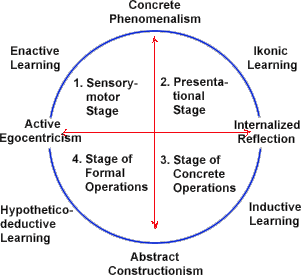

Jean Piaget
Jean Piaget
Piaget was a bit of a revolutionary, in that he was the first psychologist to say that children do not think like adults. Children are not empty vessels to be filled with adult knowledge, rather they construct their own meanings when they are presented with new information by relating this new information back to what they already know. Children have systems of organising what they know called schema.
Piaget identified 4 stages of development from birth through to adolescence. Not all adults fully achieve the 4th stage. The above diagram names the 4 stages, and appropriate learning styles for children in each of these stages. For some reason this diagram calls the 2nd stage the 'presentational stage:, where I am familiar with it is the "pre-ioperational stage". It is interesting to note on this diagram the horizontal line that describes the change from egocentric behaviour in the early stage, characterised by self talk that is spoken aloud, to internalised reflection.
My reflection:
Piaget's theory is based on his observations, and I can say that I have observed similar things. For instance, my 18 year old nephew has achieved understanding object permanency, which is an indicator that he is nearing the end of the sensorimotor stage. My nephew is experimenting with language, and it seems like every day he learns a new one. The development of language is a major part of the pre-operational stage. Magnus is at the right age to be transitioning from the 1st to the 2nd stage, so I am watching him as he progresses through Piaget's stages.
It seems quite normal to me that children do not think like adults and that as they grow up they learn new skills and are able to develop more sophisticated ways of thinking. However I have grown up in a world that has been influenced by Piaget's thinking ever since I started school.
I think the main point to take away from Piaget is that while it may seem obvious, teachers need to be aware of the stages that children go through in their development. In this way, if a teacher sees a child who may not have progressed through a particular stage, the teacher can recognise this and work out a way to help the child.
Also understanding how children develop. We all know that an 8 year old cannot write an essay about world war 2 in the way that an HSC student can, but knowing why, and what level of sophistication you can expect at different ages, and how to meet your students needs as they develop is vital.
Vygotsky is so right
note: if you click on image it becomes clearer!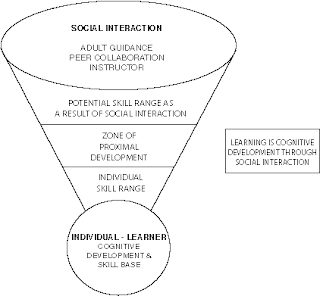
 Lev Vygotsky

 Lev Vygotsky
What is the essense of Vygotsky's thinking?
Vygotsky developed the notion of there being something called a zone of proximal development. This zone is the space between what a child can learn by themselves, and what they can learn when they collaborate with others.
According to Vygotsky, the best learning occurs through social interaction. Vygotsky's theory is like a continuation from Piaget, in that Piaget says children construct their own learning, while Vygotsky says that children construct their own learning through social interaction.
My reflection:
Vygotsky is so right. I had this experience just the other day - I was trying to create an appealing poster about me, as part of my campaign for student elections. It was no good! I am not always very good at creating things- and especially when creating documents using computer software, you need to have patience, as you try different things, and use your creativity to improve on your original ideas. I do not have patience, and when it comes to technology I am not very creative! So when my sister, who is very good at skilled at using the relevent computer software, offered to help, I jumped at the chance. The document we came up with is still my work, my ideas and words, but my sister suggested templates, fonts and colours that I wouldn't have considered, but which turned out to be perfect. My sister also acted as a sounding board, and was able to help me refine what I wanted to say. She was constructively critical, and the end result is that we developed a fantastic poster.
When we work by ourselves we are limited by our faults - in my case, impatience and a lack of attention to detail. However, when we work with others, we can be motivated to overcome our faults for the sake of the team. Also, each member of a group brings with them a different perspective, a unique creativity and problem solving skills. So when you compare the capacity of one individual to solve a problem with a group of two or more people, you can see that a group can achieve so much more.
However, once again the skill of the teacher is vital to the success of Vygotsky's theory. Not all students will be able to work together productivley. The teacher needs to ensure that the students working together have complimentary skills.
William Glasser

Choice Theory, Reality Therapy, Lead Management
Choice Theory posits that behavior is central to our existence and is driven by four fundamental psychological needs:
Love
Power
Freedom
Fun
Love
Power
Freedom
Fun
Choice Theory posits the existence of a "Quality World" in which, starting at birth and continuing throughout our lives, we place those things that we highly value: primarily the people who are important to us, things we prize, and systems of belief, i.e. religion, cultural values and icons, etc. Glasser also posits a "Comparing Place" in which we compare the world we experience with our Quality World. We behave to achieve as best we can a real world experience consonant with our Quality World.
Choice Theory posits that we are able to learn how to choose alternate behaviors that will result in greater satisfaction. Reality Therapy is the counselling process focussed on helping clients to learn to make those choices.
The Ten Axioms of Choice Theory
-The only person whose behavior we can control is our own.
-All we can give another person is information.
-All long-lasting psychological problems are relationship problems.
-The problem relationship is always part of our present life.
-What -happened in the past has everything to do with what we are today, but we can only satisfy our basic needs right now and plan to continue satisfying them in the future.
-We can only satisfy our needs by satisfying the pictures in our Quality World.
-All we do is behave.
-All behavior is Total Behavior and is made up of four components: acting, thinking, feeling and physiology.
-All Total Behavior is chosen, but we only have direct control over the acting and thinking components. We can only control our feeling and physiology indirectly through how we choose to act and think.
-All Total Behavior is designated by verbs and named by the part that is the most recognizable.
from: en.wikipedia.org/wiki/William_Glasser
MY REFLECTION:
I really like how Glasser says that the only behaviour we can control is our own, and that we make choices that determine our behaviour. This is probably because I have found this to be true in my life. I learnt many things about myself as an adolescent, and will continue to as I grow. One of the things that I learnt was that I have a natural inclination to dominate other people. For example, when I was in high school and found myself in a debate with my friends and classmates I was so sure that I was right, and that if I argues my case strongly enough then everyone else would come round to my way of thinking.... of course, I soon learnt that in trying to change my friends thinking and behaviours like this, I made my friends come to avoid getting into any sort of discussion with me, because they wanted to be able to express their opinion and be recognised for its worth. I also like the idea that we make choices that determine our behaviour, because it means that once we identify a behaviour that is not beneficial to us, we can find ways to change that behaviour, if we decide to do so. No situation is hopeless, and no student deserves to be abandoned. However, in reality therapy, the teacher is required to be extremely skillful. Reality therapy is almost like holding a mirror up to the student, and helping them to recognise their own behaviours, and develop strategies to change them. The teacher does not make judgement, and cannot overtly influence the students thinking, although the teacher should subtly encourage the student in the right direction, through asking questions and body language even. A teacher who successfully uses reality therapy will develop a fantastic relationship with the student. A student cannot focus their anger or blame on a teacher who skillfully uses reality therapy, rather they develop a relatuionship of trust.
John Hattie
 JOHN HATTI, UNIVERSITY OF AUCKLAND
 1. Content knowledge. The expert has a deep understanding of the subject matter to be taught to students.
2. Pedagogical knowledge. The expert transforms essential aspects of subject matter to connect
with students’ ways of understanding. These transformations include:
with students’ ways of understanding. These transformations include:
- identifying essential representations about teaching and learning
- have deeper representations
- are problem solvers
- setting appropriate and challenging goals for all learners
- can anticipate, plan, and improvise
- are better decision makers, and can identify important decisions
guiding learning through classroom interactions
- have excellent proficiency for creating an optimal classroom climate for learning
- have a multidimensional perception of class situations
- are context dependent and have high situation cognition
- are diverse and flexible in their problem solving
monitoring learning and providing feedback
- are most adept at monitoring and provide much feedback
- are able to check and test-out their hypotheses or strategies
- are automatic in many routines and reactions
making these transformations
- for all students
- with much passion about teaching and learning
- have deeper representations
- are problem solvers
- setting appropriate and challenging goals for all learners
- can anticipate, plan, and improvise
- are better decision makers, and can identify important decisions
guiding learning through classroom interactions
- have excellent proficiency for creating an optimal classroom climate for learning
- have a multidimensional perception of class situations
- are context dependent and have high situation cognition
- are diverse and flexible in their problem solving
monitoring learning and providing feedback
- are most adept at monitoring and provide much feedback
- are able to check and test-out their hypotheses or strategies
- are automatic in many routines and reactions
making these transformations
- for all students
- with much passion about teaching and learning
3. Learning Outcomes. The expert promotes:
- motivation
- self-efficacy
- challenge of objectives
- outcomes of lessons: Achievement
- outcomes of lessons: Surface and Deep
- motivation
- self-efficacy
- challenge of objectives
- outcomes of lessons: Achievement
- outcomes of lessons: Surface and Deep
My reflection:
Hattie is an intellectual, an academic who thrives on research. It's a little bit harder to get a grip on exactly what Hattie is about, as there is nothing called "Hattie's theory of (X)". However, the text above is an indication of what Hattie is about. There is loads more research papers and transcripts of speeches on the net presented by Hattie where he discusses things such as "measurement models and their application to educational problems".
Hattie is more concerned with the role of the teacher, or 'expert' as a facilitator to learning than he is with the learner and how they learn, unlike, say, Bloom.
This focus on the teacher is almost revolutionary. Previously, educational theory revolved around the role and practice of the teacher. Modern theory has shifted its focus to the learner, their needs, and role as the director of their learning. Now Hattie is focusing, once again, on the teacher. This is not to say that Hattie has reverted to any old theories or practices, rather that in considering modern theories, he is once again considering the role of the teacher in them.
Subscribe to:
Posts (Atom)